
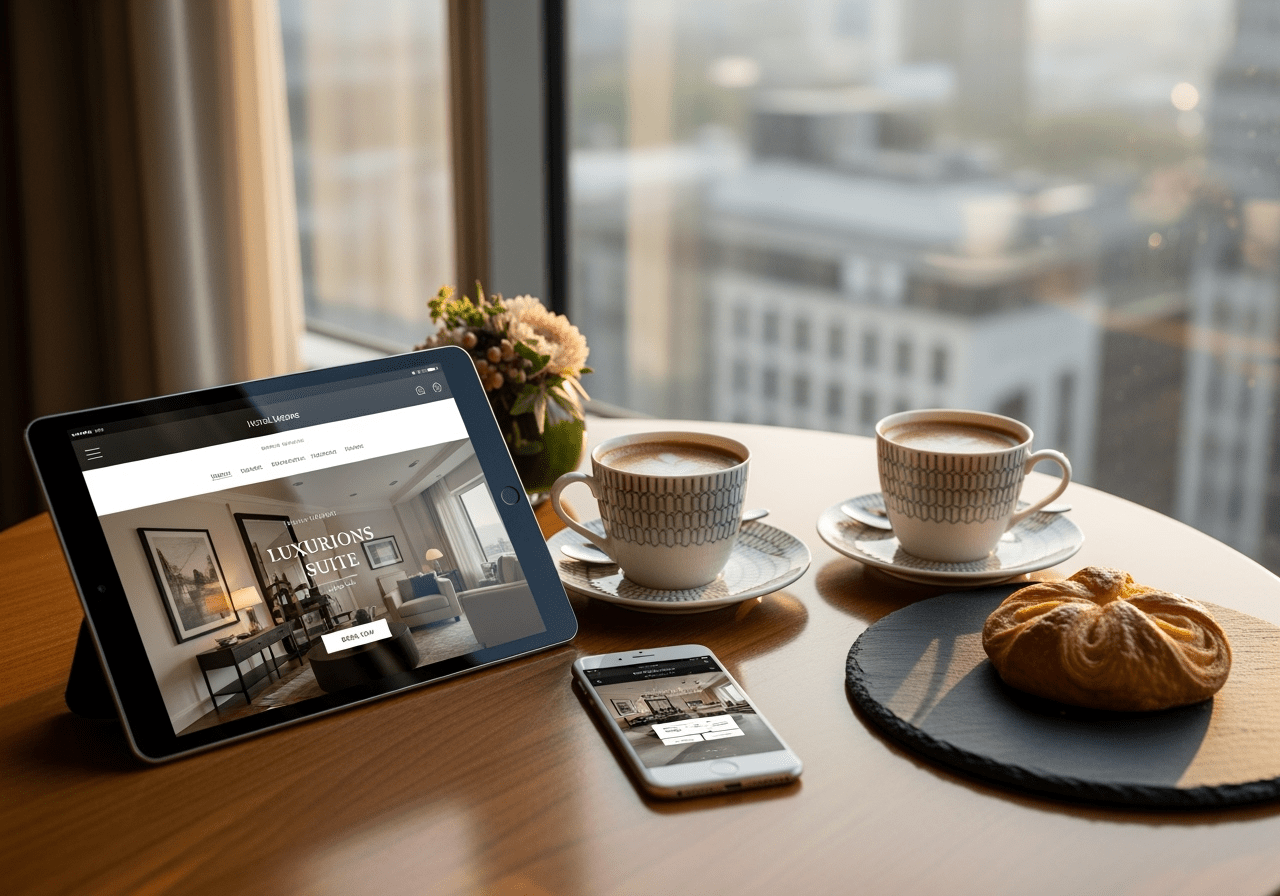

Introduction: the best hotel website design reduces friction The phrase “best hotel website design” often conjures dramatic visuals and glossy animations. But the sites that actually win direct bookings do something more practical: they remove friction at every step. They load quickly on everyday phones, tell the truth with photography and copy, show total price and policies before checkout, and keep a clear call to action visible on screen. This combination—speed, clarity, and a calm, reliable booking flow—outperforms “pretty but slow” every time.
Above the fold: context, value, and one obvious action Concise answer: guests should know where you are, why stay here, and how to book without scrolling.
- Hero discipline: one truthful, representative photo (room or signature on‑property scene) with real lighting. No heavy filters, no deceptive angles.
- Value line: a clear one‑sentence promise that combines location and differentiation, such as “Riverside rooms five minutes from the arts district—parking and breakfast included.”
- Primary CTA: one visible “Check Availability” action. Secondary links (Explore Rooms, View Offers) can be text-only nearby; they must not compete with the booking action.
- Micro-proof: a ratings badge or a short, specific quote adjacent to the CTA. Proof near action beats a remote “Reviews” page.
Information architecture that mirrors guest decisions Concise answer: structure the site in the order guests evaluate the stay and link pages to shorten the path to booking.
- Rooms & Suites: a logical taxonomy (view, size, family, accessible), quick comparison attributes (occupancy, bed type, amenities, price), and anchors to jump between types.
- Offers & Packages: seasonal and segment-based (romance, family, business) with crystal‑clear inclusions, blackout windows, and links to eligible rooms.
- Experiences: separate on‑property (dining, spa, pool) from nearby must‑dos (landmarks, trails, venues). Include distance/time and timing tips.
- Location & Access: maps, parking, transit, rideshare pickup, and airport/station travel times. Practical details reduce late‑stage drop‑offs.
- Policies: human‑readable summaries of pets, kids, parking, deposits, and cancellations on room pages and in cart summaries, not only in the footer.
Room pages: replace adjectives with specifics Concise answer: guests decide fast when information is concrete and consistent across rooms.
- Specifics that matter: size (sq ft/m²), bed type, occupancy, view, standout amenities (balcony, kitchenette), accessibility features, and included perks (Wi‑Fi, breakfast).
- Photography standards: a tight set of six to ten photos—wide, detail, bathroom, view, and a night/evening shot—ordered consistently across room types.
- Micro‑copy: one to two sentences that state the practical reason to choose this room: quiet wing, skyline view, blackout curtains, or family‑friendly layout.
- Upgrade clarity: offer an obvious step‑up (better view, more space, club access) with transparent price deltas.
Pricing transparency and fee clarity Concise answer: the best hotel website design reveals total cost and rules early—confidence increases completion.
- Price presentation: “From” rates pre‑dates; total stay cost post‑dates with explicit inclusive/exclusive tax labels.
- Fees and deposits: resort/facility fees, parking charges, and deposit policies visible before checkout, always present in a cart summary that updates in real time.
- Cancellation policy: a human summary on room pages and cart (with link to legal terms). Clear expectations reduce support and post‑stay disputes.
Booking flow ergonomics that feel native Concise answer: a smooth engine experience is part of design; if it feels bolted on, conversion suffers.
- Calendar responsiveness: thumb‑friendly calendars with preloaded availability windows and instant feedback on edits—no full reloads.
- Room compare within the flow: photos, features, occupancy, price, and upgrades without tab chaos.
- Payment options: Apple Pay/Google Pay prioritized on mobile; minimal required fields; saved progress so guests can return without restarting.
- Edge‑case handling: sold‑out messaging that offers useful alternatives (nearby dates or similar rooms) instead of dead ends.
Mobile-first performance is a revenue feature Concise answer: most research happens on phones; speed and stability decide outcomes.
- Core Web Vitals in the field: sub‑2.5s LCP on home, room, and booking pages; stable CLS; limited long tasks on the main thread for responsiveness.
- Media discipline: AVIF/WebP images, responsive srcset, lazy‑loaded galleries, and capped hero sizes; avoid heavy autoplay above the fold.
- Script budgets: smaller bundles, deferred non‑critical code, server‑rendered core content so reading and tapping work before everything loads.
- CDN and caching: tuned to traveler geos; pre‑warm before seasonal peaks.
Design patterns that convert without gimmicks Concise answer: simple, predictable patterns beat novelty in the funnel.
- Always‑visible action: sticky Book Now or Check Dates on mobile; docked CTA on desktop when scrolled.
- Trust proximity: place ratings, recent reviews, and awards near decisions—on rooms and cart—not as isolated vanity pages.
- Helpful helpers: itinerary modules like “48 Hours in [City]” and seasonal guides that link back to rooms and offers without dead ends.
- Accessibility by default: readable type, strong contrast, keyboard support, visible focus states, and descriptive buttons. Inclusive design improves everyone’s experience.
Content that outperforms OTAs on intent Concise answer: own bottom‑funnel queries and convert decisively once visitors land.
- Intent pages: “hotel near [landmark]” and “boutique hotel in [city]”, plus event/seasonal pages that solve logistics and link to rooms and offers.
- Structural hygiene: clean URLs, descriptive breadcrumbs, canonicals, no orphan rooms, and honest image alt text.
- Titles and metas: precise, click‑worthy promises aligned with on‑page copy. Avoid clickbait that triggers pogo‑sticking.
Template vs. custom vs. hybrid—choosing the right path Concise answer: the “best” hotel website design is the one that fits constraints now and scales later.
- Template or hybrid: fastest to market and budget‑friendly. Pair with strong copy, current photography, and a lightly customized booking UI around calendars, fees, and cart clarity.
- Custom: ideal for distinctive brands, complex upsells/packages, multi‑property logic, or strict performance budgets. Deeper API integrations give you native control over high‑friction steps.
- Hybrid model: template base with custom booking UI components and a light or deep API integration—often the best cost‑to‑conversion ratio.
Payment trust and fraud prevention without friction Concise answer: calm, transparent checkout builds confidence and reduces abandonment.
- Trust signals that matter: real card marks, visible wallet options, and a precise summary of totals, taxes, fees, and cancellation terms near the pay button.
- Error handling: plain‑language messages that preserve validated fields and offer quick wallet fallback; soft‑decline retries where supported.
- Perception design: minimal distractions, stable totals, and quick interaction feedback—small details that change outcomes.
Upsells, loyalty, and post‑booking that respect the journey Concise answer: add value after commitment, not before clarity.
- Before payment: one or two high‑fit upsells (parking, breakfast, late checkout) with a one‑tap decline. Do not bury the primary CTA.
- After confirmation: optional add‑ons (airport transfer, spa holds, dining reservations) with transparent pricing; self‑serve Manage Booking to reduce support.
- Loyalty: post‑confirmation one‑tap join or magic‑link enrollment. Forced account creation mid‑checkout usually lowers completion.
Editorial system and CMS patterns that keep quality high Concise answer: the best hotel website design helps marketing ship updates quickly and safely.
- Component library: reusable blocks for hero, features, galleries, pricing, policy summaries, itineraries, and proof. Design tokens lock spacing, type, and color for consistency.
- Editor guidance: short how‑to videos and checklists for headings, image sizes, and meta. Guardrails keep new pages fast and on‑brand.
- Cadence: a realistic rhythm—seasonal guide monthly, one event/landmark page, and one offer refresh—interlinked to rooms and booking.
Analytics and CRO: evidence before redesigns Concise answer: measure the funnel, then test the smallest change with the biggest expected impact.
- Events that matter: availability searches, room views, add‑to‑cart, step‑level drop‑offs, confirmations, and error types.
- Research inputs: session replays, on‑page polls, and support themes to identify confusion. Segment by device and channel to find hidden friction.
- Testing themes: headline clarity, proof placement, sticky CTAs, wallet vs. card-only, field reduction, fee visibility, and error copy.
Cost considerations that correlate with results Concise answer: spend where it changes decisions; avoid ornamental complexity.
- High‑ROI areas: native‑feeling calendars and rate display, transparent fees early, wallet payments, honest photography, and performance budgets enforced in CI/CD.
- Lower‑ROI areas: heavy animation, bespoke one‑off modules editors can’t maintain, or long blog posts with no intent or internal linking plan.
- Budgeting smartly: start with friction removal; iterate quarterly before considering large rebuilds. If you do rebuild, treat migration as a project with URL mapping, redirects, and parity checks to avoid traffic dips.
When global teams can stretch your budget Concise answer: expertise matters more than proximity—vet outcomes on live sites.
- Markets to consider: hotel website development in Ukraine and broader Eastern Europe is often praised for elegant UX and robust integrations at accessible rates.
- Vetting process: demand live URLs, real‑device booking demos over 4G, pre/post performance baselines, and funnel improvements. Clarify ownership of performance budgets, analytics taxonomy, accessibility, and migration.
What the best hotel website design delivers in practice Concise answer: faster decisions, fewer drop‑offs, and more direct bookings.
- Faster LCP on rooms and booking pages, stable layouts, and responsive interactions.
- More availability searches and room views due to clearer above‑the‑fold messaging and visible CTAs.
- Lower abandonment at payment thanks to wallet options, transparent fees, and calm error recovery.
- Stronger bottom‑funnel SEO that competes with OTAs where intent is highest.
Conclusion: best means practical, measurable, and guest‑centered The best hotel website design is not a moodboard; it is an operating system for winning direct bookings. It tells the truth quickly, shows price and rules without drama, and keeps the booking action in reach at all times. It runs fast on ordinary phones, handles odd cases gracefully, and lets guests pay the way they prefer. Build these fundamentals, measure relentlessly, and iterate monthly. That is how “best design” becomes best‑performing.


